Neighbourhood Health & Integrated Neighbourhood Teams
Neighbourhood health aims to create healthier communities, helping people of all ages live healthy, active and independent lives for as long as possible while improving their experience of health and social care, and increasing their agency in managing their own care. This will be achieved by better connecting and optimising health and care resource through 3 key shifts at the core of the government’s health mission:
- From hospital to community – providing better care close to or in people’s own homes, helping them to maintain their independence for as long as possible, only using hospitals when it is clinically necessary for their care.
- From treatment to prevention – promoting health literacy, supporting early intervention and reducing health deterioration or avoidable exacerbations of ill health.
- From analogue to digital – greater use of digital infrastructure and solutions to improve care.
Integrated Neighbourhood Teams (INTs)
All parts of the health and care system (primary care, social care, community health, mental health, acute, and wider system partners) will need to work closely together to support people’s needs more systematically, building on existing cross-team working, such as Primary Care Networks, provider collaboratives and collaboration with the voluntary, community, faith and social enterprise (VCFSE) sector.
- NHS and social care working together to prevent people spending unnecessary time in hospital or care homes.
- Strengthening primary and community based care to enable more people to be supported closer to home or work.
- Connecting people accessing health and care to wider public services and third sector support, including social care, public health and other local government services.
The full vision for the health system will be set out in the 10 Year Health Plan, including proposals to help make this emerging vision for neighbourhood health a reality, informed by existing work and public, staff and stakeholder engagement.
How This Effects Community Pharmacy
The Government’s plan is centred around its three healthcare shifts: sickness to prevention, hospital to community, analogue to digital. Below is a summary of the announcements within the NHS 10-year plan that specifically reference community pharmacy.
Pharmacy as a high street health hub:
-
- Community pharmacies will become integral to managing long-term conditions, obesity, high blood pressure and high cholesterol.
- Pharmacists will be able to independently prescribe and contribute to complex medication regimens.
- Inspired by Canada’s Pharmacy Care Clinics, UK pharmacies will offer minor ailment support and long term condition management.
- Expansion of pharmacy roles in vaccine delivery and screening for cardiovascular disease and diabetes.
Prevention and public health:
-
- As previously announced, pharmacies will deliver emergency hormonal contraception for free by the end of 2025.
- From 2026, pharmacies will administer HPV vaccinations to women and young people who missed them in school.
Digital tools and integration:
-
- Pharmacies will be securely linked to the Single Patient Record, enabling seamless care and visibility for GPs.
- Patients will be able to manage medicines, book vaccinations and access pharmacy services via the NHS App.
- Pharmacy innovations will be surfaced through the HealthStore – a digital marketplace for approved health tools.
Modernising dispensing:
-
- Plans to modernise dispensing medicines using robots and Hub and Spoke models.
- Public and sector engagement on proposals to ensure 21st-century readiness.
Cost of living and access:
-
- As previously announced, prescription charges have been frozen to support affordability.
- As previously announced, investment in pharmacies to provide mental health support (through expansion of the New Medicine Service) and accessible care on the doorstep.
Weight loss medication
-
- The NHS will expand access to weight loss services and treatments, including GLP-1 medications like tirzepatide, through innovative delivery models which may involve community pharmacies as convenient access points for patients.
- The Government is establishing partnerships with industry to offer treatments on a “pay for impact on health outcomes” basis, which could further integrate pharmacies into long-term obesity management strategies.
Neighbourhood Health – The Future of Community Pharmacy
What is Happening in West Yorkshire
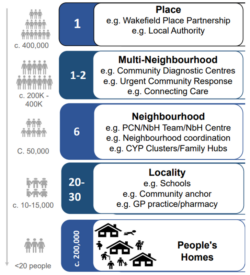
Across West Yorkshire, each Place is developing its Neighbourhood Health Strategy, identifying the neighbourhood areas and consulting on the creation of multi-disciplinary teams and agreeing medium term strategies. This involves analysing data to identify key patient cohorts, specific to each neighbourhood, on which the neighbourhood teams will focus their strategy. Each Place has also identified Medium Term priorities, common to all neighbourhoods.

Neighbourhood and Priorities
Please follow the links below to see the current status of neighbourhoods and where available, the priorities/target patient cohorts in each area. In most cases, neighbourhoods will cover the same footprint as the Primary Care Networks.
Bradford District & Craven ICB – Neighbourhoods & Local Priorities
Calderdale ICB – Neighbourhoods & Local Priorities
Kirklees ICB – Neighbourhoods & Local Priorities
Leeds ICB – Neighbourhoods & Local Priorities
Wakefield ICB – Neighbourhoods & Local Priorities
CPWY Strategy & Resources
The CPWY strategy of engagement with Neighbourhood Health will evolve over the coming months as neighbourhoods themselves progress and mature. At this point in time the CPWY strategy is:
- Promote Community Pharmacy’s National Advanced Services (Pharmacy First, Pharmacy Contraception Service & Hypertension Case Finding) as ‘enablers’ creating capacity within GP practices. This supports the objectives laid out in the Medium Term Planning Framework – delivering change together 2026/27 to 2028/29. “In implementing neighbourhood health, the immediate focus must be on:
- Improving and tackling unwarranted variation in GP access for the whole population.
- Reducing unnecessary non-elective admissions and bed days from high priority cohorts – people who have moderate to severe frailty, people living in a care home, people who are housebound or at the end of life.
- Enabling patients requiring planned care to receive specialised support closer to home.
- Promote Community Pharmacy Role in the Identification and Management of Frailty
- Promote Community Pharmacy as a Core Member of Provider Partnership Discussions, ensuring that community pharmacy is recognised as a key primary care partner and provider of services in the neighbourhoods.
Contractor Support
CPWY would like to know if you are approached by local GPs or PCN colleagues to discuss Neighbourhood Health and Integrated Neighbourhood Teams (INT). Please email info@cpwy.org.
Attending Meetings
Pharmacy contractors may be asked to attend Integrated Neighbourhood Team meetings. CPWY is happy to support individual contractors with guidance and/or bespoke resources if required. Please see examples below.
Contractors may also be invited to attend Multidisciplinary Team Meetings designed to review the care and management of individual patients. While many may be interested and wish to contribute to these discussions, CPWY’s current view is that community pharmacy should be consulted/invited to these meetings when specific community pharmacy input is required, rather than as a regular attendee.
Resources
Community Pharmacy – A Unified Partner in Neighbourhood Care
Neighbourhood Health – The Future of Community Pharmacy
The Community Pharmacy Offer Frailty Rebranded (Presentation)
The Community Pharmacy Role – Supporting Neighbourhood Health
Community Pharmacy: A Vital Partner in Neighbourhood Health – Existing Services
Last Updated: 13th May 2026